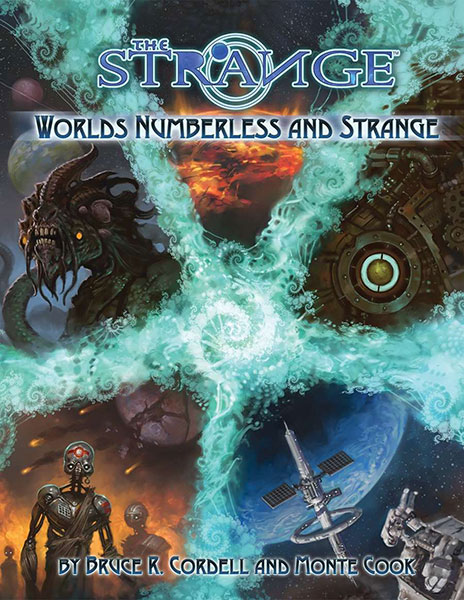
Worlds Numberless and Strange by Bruce R. Cordell is a role playing game supplement published by Monte Cook Games for use with Cypher System and The Strange. This requires The Strange Corebook to use.
The supplement is available as a PDF from DriveThruRPG for $16.99 and is also available in printed form from sites such as Amazon. The PDF is the version reviewed although it was purchased at a reduced price as part of a special bundle. It has 226 pages with one page being the front cover, one blank, two the front matter, one the Table of Contents, one being the Index and two being ads.
Part 1: Explore • Create • Defend starts with Chapter 1: Introduction, a single page written by the author with a sidebar explaining how the sidebar references to The Strange core book are laid out.
 Chapter 2: Exploring Fictions looks at how worlds are created from fictions and explains that there are no multiple parallel worlds. Some worlds are fused to their original narrative whilst others are more open. It looks at how the Strange is home to recursions, how Earth has avoided the fate of other worlds, so far, and its special connection to the Strange thanks the collision that formed the Moon which was caused by part of the mechanism used to create the Strange. It looks at how other worlds may be visited and the laws that govern different worlds. Much of this material will be familiar from the core book. Finally, it looks at a new organisation, the Implausible Geographic Society, an offshoot of the Royal Geographical Society of London, the first known people to discover recursions, though they are very secretive. Details are provided on the IGS, which has extensive records and this includes details on recursions based on fictions that are no longer as popular and which can no longer be found.
Chapter 3: Importing Fictions and Game Worlds is a brief chapter on how to import fiction to make recursions in the Strange, whether the fiction be another RPG setting or something from other media. It suggests starting with the familiar, perhaps something the players have already encountered, explains that as NPCs don’t use the same rules as PCs only a few things need assigning to them stat-wise, that just important ones need initially focusing on and that you should only import the parts of the setting that will be immediately used, and what to do when the edge of a recursion is investigated; in many cases, the fiction doesn’t have a literal edge, and so the edges are hidden.
Part 2: Worlds Numberless starts with Chapter 4: Ardeyn and Ruk Expanded. This expands the details on Ardeyn’s Glass Desert and its inhabitants, as well as having various new artefacts connected to the area. For Ruk, it explains how Earthborn are in demand and how they are recruited, covers a district of Harmonius known as the Scar, a Strange vessel called the Resolution and its mission and finally some new artefacts for Ruk.
Chapter 5: Recursions starts by explaining that fictional leakage created the vast majority of the recursions described in the corebook, and a few were purposefully created or modified. The corebook describes several recursion in enough detail to run encounters or entire adventures in them and that this describes more. Recursions have several attributes. Level determines how difficult it is to translate into. Laws broadly determine the kinds of rules that exist there, and without certain laws to support them, recursions can’t have certain foci, effects or inhabitants. The laws include standard physics, magic, mad science, psionics, substandard physics and the catch-all of exotic. Recursors may choose to translate into something native to the recursion the first time they translate. Foci may also be changed, and other sources for foci can also be used as well as the base options listed for each recursion. There can be skills unique to a recursion, how the recursion is connected to the Strange and Earth are covered, how big the recursion is, what percentage of inhabitants have the spark and traits that could affect a recursor. There is also a default location given that first time recursors translate into a recursion. There is a random list of recursions, with those in the core book marked.
The rest of the chapter is taken up by describing the recursions. Each is given a fairly standard layout, with a description, including what it originated from, foci, sidebar covering the attributes, another covering what recursors know about the recursion and details on some important NPCs and locations, rumours and details on associated artefacts. Some recursions are covered in more detail than others, and some have specific things of interest different to the others. There are seventeen new recursions described, Atlantis, Camelot le Morte, Eleventh Reich, Halloween, Mesozoica, Microcosmica, New Centropolis, New York Grey, Oceanmist, R639, Rebel Galaxy, Samurai Sky, Seishin Shore, Starship Heinlein, Sword Realms, Wuxia City and Zed America, which cover a whole range of genres.
Chapter 6: Recursion Seeds starts with some basic information. The given names of recursions is often a code bestowed by explorers, that some are so exotic that foci are often limited and that this is only a selection of those available, which is in easily the thousands and growing. A sidebar looks at artefacts. The recursions follow. Each is given a name, the law it operates under and a description of it and points of interest, often including their fictional origins. None of these recursions is detailed as thoroughly as in those in the previous chapter, with a few paragraphs at most with sidebar information. Some of them are extremely lethal to visit. Quite a few recursions are described in this way; the GM will probably need to do a bit more work with them.
Part 3: Worlds Strange starts with Chapter 7: Character Options. This chapter has eight new foci described in the standard way, with a description, six tiers and sample GM Intrusions. A couple of these in particular are most related to two of the new recursions described in this supplement, Halloween and Microcosmica, whilst others are appropriate for some of the recursions and also have wider roles.
Chapter 8: Creatures starts by explaining how to understand the listings, which follow the same system that the corebook does and the Cypher System in general. Each has a description, stats, interactions, GM Intrusions and in-game use, and are usually one creature to a page. Most have general recursion types they can be found in, with some being more common in specific recursions.
Part 4: Back Matter has Resources and Inspiration lists the major works of fiction that seeded the named recursions; in other words, the inspiration behind the writing. It also has the Index.
Worlds Numberless and Strange in Review
The PDF is bookmarked with major and minor sections linked. The Table of Contents only covers the major sections but is hyperlinked. The Index is thorough and is hyperlinked, and also lists relevant material in the core rulebook. In addition, there are many internal hyperlinks within the sidebars. Navigation is good. The text primarily maintains a two columns with sidebar format and appeared to be free of errors. The sidebars are used for additional details, game stats, internal links and references to other material. There are extensive colour illustrations, up to full page in size. Presentation is good.
This is an additional sourcebook for The Strange, and therefore needs the corebook in order to be used. The main part of it is expanding the existing major recursions of Ardeyn and Ruk. The other recursions covered in the most detail are covered in a similar level of detail as the Other Recursions in the corebook, and the seeds are not much more than a description. This means that Ardeyn and Ruk have much more detail on them than anything else, followed by some more lightly covered recursions and some that are barely covered. It would have been nice to have some of the Other Recursions from the original book expanded, rather than just having two greatly detailed recursions and lots more that need work doing to them. This definitely means that the focus of The Strange supplements is tilted most heavily towards some major areas.
The book also has a few new character options, though these are heavily tilted towards some specific recursions, making them generally less useful, as well as having some new monsters that can be used in various places. On the whole, there’s a lot of new material in the book, though Ardeyn and Ruk have perhaps too much focus overall. Worlds Numberless and Strange can be found by clicking here.
Leave a Reply