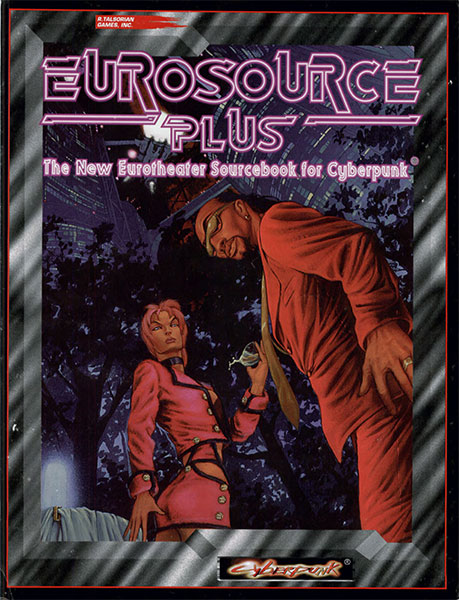
Eurosource Plus is a role playing game supplement published by R. Talsorian Games Inc. for use with Cyberpunk 2.0.2.0.
The supplement is available as a PDF from DriveThruRPG for $8, as a softcover print on demand book for $22.99 or as both PDF and POD for $26.99. It’s also available in printed form from sites such as Amazon. The PDF is the version reviewed although it was purchased at a reduced price as part of a special bundle. The PDF has 146 pages with two being the front and rear covers, one and a half the front matter, one the Table of Contents and one is an ad.
A brief introduction explains that after the release of the Pacific Rim Sourcebook, it was felt that Europe needed treating in the same way. Not mentioned in this, but mentioned on the back cover, is that this book replaces the original Eurosource book and predates events in Rough Guide to the U.K.
 Fortress Europe is a short chapter that explains that there are legal and illegal ways to get into the EC. The land borders are still in place and still taken care of by the separate countries, and there are details on the different borders, their security and the border police. The coasts are patrolled by the Navy. Euro cards are difficult to get hold of and temporary ones are very limited; permanent cards for European residence are much better and even harder to obtain. Artistic IDs are awarded for cultural contributions; often the repatriation of European art. Eurocitizens can visit any time, getting into Scandinavia is even harder and getting into the NCE is easy.
Who Runs Europe? starts by explaining that Europe is run by money. Only taxpayers can vote and the size of an EC constituency is based on the amount it pays into Europe, effectively making the richer countries have more sway. All countries but Britain, currently under martial law, have elections. The different countries are allowed a number of councillors on the European Council based on the money they pay in; councillors are the highest-ranking politicians. The Secretariat is the civil service, which controls what the councillors see and might vote on, as well as recruiting from within their own groups, effectively making them the power behind the throne.
The European Commissions are divided in Finance, Interior, Interpol, Trade, Exterior, Defence, Technology, Communications, Population, Food and Energy. These have various different areas of authority, and details are given on various subdepartments of the commissions and what they are specifically responsible for, when such exist. There is also a flowchart showing how the different political entities are linked. Throughout the chapter are also NPC dossiers on various important figures and various different types of sidebars providing extra information. Finally, there is a map of Europe.
The Major Powers looks at the major powers of the EC. It starts with a timeline of Greater Europe events from 1990 to 2020. The powers are divided into France, Benelux and Germany. Each has some stats for the country, as well as an overview, government, background and culture and a regional guide to important places; Germany also has sections on politics, business and spare time.
The South starts with a timeline from 1997 to 2020 and then looks at the countries. These are Spain, Portugal, Italy, Greece and Turkey, having country stats, an overview of each country and some more details on specific parts of it. Turkey has some more depth on the government and the economy. Finally, there are connections to Africa and the Mediterranean; the Med is a dead sea partly due to a number of historical factors but it was finished off by missiles and fallout during the Meltdown War, leaving it radioactive and killing the tourist economy.
New Central Europe looks at the countries, which are Poland, the Czech Republic, Slovakia, Hungary, Romania, Bulgaria and the Splinters, the last being the various parts of the former Yugoslavia. Each has country stats, an overview of the country and in some cases more details on some specific parts of it. All but the Splinters have details on the government, and of the rest all but Hungary have details on the economy.
The Margins starts by looking at the major countries of the margins, which are the United Kingdom, Ireland, the Nordic Countries and Russia. These are covered in the most detail, with country stats, an overview of the country and again in some cases details on some specific parts. Things such as economy, government and history may be covered, but often not in specific sections. Ukraine, Belarus, Moldova, the South (former Kazakhstan, Kyrgyzstan, Turkmenistan and Uzbekistan) and North-West Africa (Morocco, Algeria and Tunisa) all have country stats, but are generally only given a small amount of detail, with more space given to North-West Africa and post-modern Islam, including a timeline for the region’s problems.
Class and Eurostyle starts by explaining that Europeans take class very seriously. The upper classes consist of the old nobility, the Goldenkids, the latter being the new rulers of Europe, and more time is spent on the latter, how they started, their life and their children, and the Eurocrats, these being in theory public servants, but in fact carefully chosen by the Goldenkids to advance their aims, though they do still have power of their own. There are other prominent groups, with a few paragraphs devoted to each; sport fans, hooligans, androgynes, Goths, Vlads, the New Templars, music fans, surprise parties and stay-ins. European style is covered, starting with cyberstyle, which includes nanotech and bioengineering, with prices for these. Nationalism, despite the EC, is still part of life for many. Everyday life in Europe is covered, including how Europe seems to be a model or two behind the US and Japan when it comes to technology. This also covers education.
Entertainment is television, the primary form of entertainment, with there being thousands of channels, most of them legal and providing similar content, but on top of that there are pirate channels which have different material. Other forms of entertainment are live acts, sports, extreme sports, hobbies and pets. Religion is briefly covered, then it moves onto the economics and income in Europe, including the differences between the unemployed and the employed, and working for big companies and the Secretariat. Taxes and shopping, as well as basic monthly costs by region for various regular payments are given, as well as home shopping and plug and play stuff.
Transportation looks at getting around and moving goods, including by tunnels, one of these being the Gibraltar tunnel linking to Northern Africa. Private transport and how it’s taxed and treated is next, as well as public transport. The law and law codes are covered, and finally organised crime, which in Europe is big business.
The Roles in Europe looks at how the different roles fit into the continent. It starts off by listing the different roles and how they dress, which does tend to be consistent, even though it may change as they advance. Solos, netrunners, medias, cops, corporates, nomads, fixers, techies, medtechies and rockerboys are all covered individually, detailing how they operate in Europe. Runners, who hop the borders, and spies, are also briefly covered, though these are not from the core book but from When Gravity Fails. Finally, there are lifepath modifications for European PCs.
Eurosource Plus in Review
The PDF is bookmarked, with major sections and subsections linked, as well as some sidebars, though not every minor subsection. The Table of Contents only covers the major sections and subsections. Navigation is good. The text maintains a two-column format and a number of, often consistent, errors were noticed. There are a variety of custom black and white illustrations up to full page in size. Presentation is good.
Perhaps the first thing to note is that this is based on a scan of a physical book. It’s a good scan, but at times it’s easily noticeable it’s a scan, and isn’t quite as good as a purely digital file would have been. The supplement covers everywhere in Europe, but despite this being a single political group, as well as some parts on the fringes, Europe still consists of many different countries with different cultures. There’s a decent overview of them all, but none are covered in a truly great level of detail, given how many places needed covering, as well as the EC itself and the roles. However, the book still functions as a decent overview of the continent, making it possible to run campaigns or excursions there, and enough detail is given to provide various ideas. Eurosource Plus can be found by clicking here.
Leave a Reply