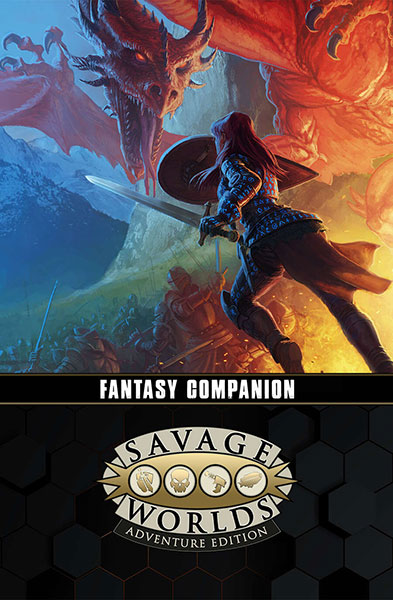
SWADE Fantasy Companion is a role playing game supplement published by Pinnacle Entertainment for use with Savage Worlds Adventure Edition.
The supplement is available as a PDF from DriveThruRPG for $24.99 and in printed form from sites such as Amazon. The PDF is the version reviewed, although it was purchased at a reduced price during a sale. It has 274 pages with one being the front cover, two the front matter, two the Contents, four the Index and one the character sheet.
Chapter One: Characters starts by explaining that this supplement is intended to help play fantasy games with SWADE, with a breakdown of what’s in the book.
Following this are some new ancestries, which use the same format as in SWADE, though where any duplicate the core ones the version in this overrides them. There are notes on using ancestries in Savage Pathfinder, making choices with them, evil cultures, inherent powers, names and some cultural packages, along with new ancestral features. There are twenty-nine ancestries covered, most new but some, as mentioned, being the same as those in the core book.
 These are followed by some new Hindrances, again following the same format, and a page on how to use Savage Worlds, which lacks classes, to create the equivalents of many fantasy classes.
There is a single new skill, Alchemy, and an explanation that animal handling will use either Persuasion or Intimidation, rather than a new skill. After this are some new Edges, divided into Background, Combat, Power, Professional, Social, Weird and Legendary.
The chapter finishes with summaries of the new Hindrances and Edges.
Chapter Two: Gear starts by explaining that fantasy characters start with $300 not $500, which brings it in line with Savage Pathfinder and means the gear in this chapter can be priced the same way. In addition, some items in the chapter may differ from their Savage Worlds listing to reflect the change or bring them in line with traditional fantasy.
The rest of the chapter covers the gear, both new and changed. This starts with general gear, animals, food, clothing, packs, which contain specific items depending on the pack’s purpose, lifestyle costs, hirelings, lodging, travel and masterwork items, the last being of superior quality. A sidebar explains that prices are listed in gp, or gold pieces, and some settings may require different currencies. Also covered are poisons, as including how to deliver them, craft them, buy them and antidotes, weapons, armour and shields, including barding, black powder weapons, siege engines and cannons. Finally, there are alchemical items and a sidebar mentions the new Alchemy skill.
Next, strongholds are covered. There are rules for creating a stronghold in general terms, by rolling its advantage, complication, form and upgrades. Advantage is the positive factor the stronghold has; complication the negative factor. How to acquire and maintain a stronghold is covered and a list of room upgrades and the benefit these generate. Upgrading a stronghold will cause an encounter, and there is a list of these. There are some general guidelines on medieval castles, their types and laying siege to such, with simple rules on running a siege.
The final part of this chapter covers traps and how to craft them, with a list of sample traps, both magical and mechanical, and a sidebar looks at the effect confined spaces can have on traps by determining who might be affected due to marching order.
Chapter Three: Setting Rules starts with some updated rules from SWADE, in particular related to Bound and Entangled, as the entangle power was too powerful, and on limited actions. There are some new rules for use in a fantasy campaign, with a new type of attack, a Stream Template and the hazard of high altitude. Betrayal and difficult healing are followed by options for downtime, what the characters can do between quests and the game effects of such. The effect of fighting foes that are two or more Scales different is covered, and Villainous Conviction, gained by the central villain and which makes them more powerful. Finally, the different styles of fantasy are covered, with an overview of the style, appropriate setting rules to use and examples, which last cover different media, books, films, TV series and other role playing games.
Chapter Four: Arcana expands on the material on magic from the core book. It starts with Arcane Backgrounds, with rules on having multiple ones, as well as a sidebar on how to customise them, and describing the new ones. The new Backgrounds are Alchemist, Bard, Cleric, Diabolist, Druid, Elementalist, Illusionist, Necromancer, Shaman, Sorcerer, Summoner, Tinkerer, Warlock/Witch and Wizard. Each has its own features and abilities. It then covers how powers are activated, which is essentially how spells are cast. Trappings are things that allow the core powers to have a different appearance; these can make a difference, such as the difference between a fire spell and an ice spell can affect targets differently, especially if the targets have different strengths and weaknesses. There are some rules on cantrips followed by arcane devices, which are temporary magic items infused with spells or miracles. Battle magic and prepared powers follow; this includes ritual magic.
Domains are things that can be used for a world’s deities and the powers they provide their servants; each is described along with suitable powers. The domains are comparatively broad. Powers themselves are then covered; some are new in this book whilst others update the description from earlier editions of the core book. Each spell is marked as to which it is. The powers are all fairly standard, and finally there is a table summarising them.
Chapter Five: Treasure starts by looking at placing treasure; different creatures and different places will have it placed differently and powerful items owned by intelligent beings will be used, if they can be. It looks at how magic items might be detected and identified. Next it looks at different types of treasure, and explains how magic items are used. There is a short table of four different sizes of treasure hoard for determining what’s in them. Following this are tables for magic items, with a major table for determining the type, with three specific entries as well, followed by tables for armour, shields, melee weapons, ranged weapons, arrows or bolts, jewellery, potions, scrolls, tomes and wondrous items. Some have sub tables for determining specific properties and some have overall descriptions of the item type. Following this are descriptions of specific items. Many of the magic items are of familiar types for fantasy settings, even if the names and descriptions are different.
It then has some relics, which are legendary items that must be found. They will then need a ritual to use them for whatever major purpose is wanted, after which the relic will vanish, disappear, crumble or go dormant until another generation, and there are some brief descriptions of sample relics.
Finally, there are instructions on how magic items are crafted and what’s needed to do this.
Chapter Six: Bestiary starts with some new special abilities and one modified one from the core rules. The bestiary is naturally one that concentrates on fantasy creatures, the majority of which are easily recognisable, with various NPC types as well. The format follows the same one from the core book.
Appendix A: World Building explains that you can use an existing world, but you can also create your own. There are tips on creating your world, from having it be logical, if it should be logical, to what the world is about, to why you should start small, detailing a small area and then providing links from one adventure to another and expanding the area in question.
Appendix B: Planes starts with a general discussion on planes in fantasy settings, from their size to the complexity of the cosmology, from one plane to many. This is followed by a number of sample planes. These are divided into Chaos, Death, Elemental, Heaven, Hell, Limbo, Mirror, Nexus, Order and Prisons. Each section starts with a general explanation as to what these types of planes are like, then specific examples, two for all but Heaven, Hell and Order, which only have one. Each example is named, described and given some game effects, as well as how they might be used in different settings.
SWADE Fantasy Companion in Review
The PDF is bookmarked with major and minor sections linked. The Contents is less thorough and is hyperlinked. The Index is decently thorough and is hyperlinked. Navigation is good. The text maintains a two-column format and appeared to be free of errors. There are a number of colour illustrations, up to full page in size. Presentation is good.
This is, as it states, a supplement for helping play SWADE in a fantasy setting. The core book can be used for that as is; this just adds more options and depth because the core book is intended to be multi genre. This can still be used in various genres or, rather, sub genres of fantasy, though it is more aimed at traditional high fantasy settings than anything else. It provides new options for characters as well as expanding on existing ones or altering them to be more suitable for fantasy. Some of the changes are fixes to things in the core book as well. Nothing in the supplement is groundbreakingly new; it just makes SWADE more of a fantasy game when the Fantasy Companion is used. Fantasy games can be played with the core book, but this book will improve on them and is therefore recommended for anyone planning to use SWADE in a fantasy setting. For one thing, it greatly increases the bestiary on top of everything else. SWADE Fantasy Companion can be found by clicking here.
Leave a Reply