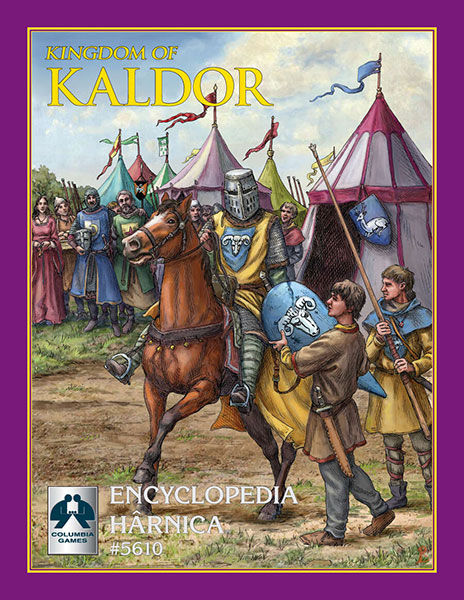
Kingdom of Kaldor by Robin Crossby, Ed King and John Sgammato is a role playing game supplement published by Columbia Games Inc. for use with Hârn and HârnMaster.
The supplement is available as a PDF from DriveThruRPG for $39.99 and is also available in printed form from sites such as Amazon. The PDF is the version reviewed although it was purchased at a reduced price thanks to a special discount. It has 64 pages with two being the front and rear covers and two are blank.
The first two pages of content have a political map of Kaldor followed by a player map of the country.
 The first page of writing explains where the kingdom is, that though Kaldor is the dominant political power there are various tribal nations in the region and some overviews of parts of it. The sidebar has the location, relevant atlas maps, government, king, culture, population, royal seat and largest city.
History has a chronology of the region as well as more detailed descriptions starting with the elder peoples, the arrival of the Jarin, and Lothrim’s conquest of the region. It then looks at the four kingdoms that arose after Lothrim was lost, with some details on these in a sidebar. A series of wars known as the Migration Wars are covered along with a map of them.
Ruling Houses of Kaldor has the various houses and the periods in which they ruled, with a sidebar listing the kings.
The House of Elendsa covers the rulers from this house, culminating in the current monarch.
Kaldoric Succession looks at the potential successors to the king, with the sidebar covering succession law and Kaldoric subinfeudation.
Natural Resources looks at the resources the kingdom has in general, as well as in some specific regions.
Economic Data has a list of settlements and resources, with indications whether they produce a surplus, need that resource or are self-sufficient. A sidebar looks at markets and fairs.
Religion explains that the churches of Larani and Peoni are dominant, with the other religions in the area, although worship of Agrik, Morgath and Naveh is punishable by death. The Church of Larani is covered in more detail, with a map showing its dioceses in the country.
Food and Drink looks at this, with a sidebar covering entertainment. Kaldor is known for outstanding troupes of thespians and travelling harpers.
Clothing and Dress looks at these.
The heraldry of the great clans of Kaldor is illustrated and then described, followed by the genealogy of Clan Elendsa.
Government covers the royal government along with its structure and wages for various positions.
Shires and Hundreds explains that the country is divided into seven shires, each of which is then divided into hundreds. The shires are administered by sheriffs who are powerful but not hereditary nobles. Two regions are marches but not yet shires. A table lists the shires, each shire’s hundreds and each hundred’s moot and market, if it has the latter two.
Forest Hundreds looks at the unpopulated regions administered by forest wardens.
Military Resources has lists of the fiefs, type, grid location, holder, guard, manors, acres and households. Along with this is the feudal levy, the Church of Larani’s feudal obligations, garrisons and the royal troops.
Kaldor Subinfeudation lists the major settlements, the manors owing fealty to them and key political and economic data, with explanations of what these mean. The majority of the rest of the supplement is taken up by these descriptions, which include the Church of Larani, and the descriptions also include notable figures and details on them.
The final two pages of content lists all Kaldorian settlements on the Atlas Hârnica maps. Each is given the name, its corresponding major settlement and the page of the supplement where that major settlement is detailed. Settlements that are held by the Church of Larani directly are marked.
Kingdom of Kaldor in Review
The PDF lacks bookmarks and at this length with this many sections, they were really needed. Navigation is poor. The text is either two columns or single column with sidebar and appeared to be mostly free of errors. There are a variety of colour and black and white illustrations. Presentation is good.
This supplement describes a major country of Hârn in a good amount of detail, though it lacks any HârnMaster stats and can therefore be used with any system. Kaldor is a large enough country that incorporating it into another setting would be difficult, though not impossible. At full price, it’s one of the more expensive country books around, and it’s best purchased at a discount. Quite a lot of different aspects of the kingdom are covered, though naturally there is more, and such tends to be available in separate supplements covering organisations and locations. Kingdom of Kaldor can be found by clicking here.
Leave a Reply