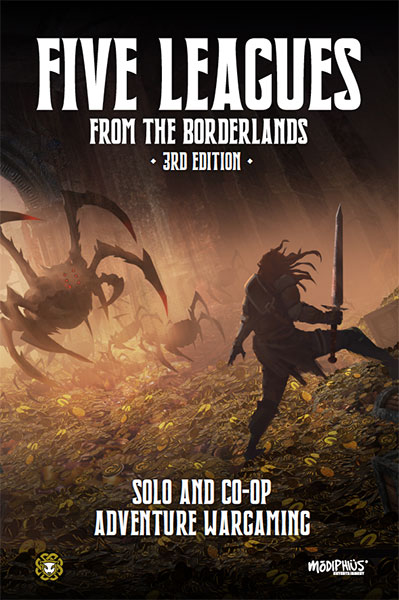
Five Leagues from the Borderlands by Ivan Sorensen is a role playing game published by Modiphius.
The supplement is available as a PDF from DriveThruRPG for $20, as a retail book from Modiphius via DriveThruRPG for $44.99 or as both book and PDF for $44.99. It is also available in printed form from sites such as Amazon. The PDF is the version reviewed although it was purchased at a reduced price during a sale. Two pages are the front and rear covers, two the inside covers, one the front matter, one the Contents, five the Index, one the Tables Index and two are ads. There are also two supplementary PDFs; a single page campaign tracking sheet and a single page warband roster.
Part 1: Setting Out starts with the Introduction, which explains that this is the third edition of a miniatures game with procedurally generated battles and the sister game of Five Parsecs from Home. It explains the terminology used and what’s needed to play; miniatures, measuring tape, the warband roster sheet, pencil, eraser, index cards, some way of marking terrain, d6s, d10s and d20s. If a natural number is rolled, this has a different effect. Time is measured in campaign turns, which are weeks, battle rounds, about 30 seconds, and exchanges, about a second or two. The game is gritty, low-fantasy with a horror tinge. The game can be hard to survive but there are options that can be used once a campaign to fix a problem; the entire warband escapes, a character ignores a roll on the Injury Table or Flight in the Dark Table, a new Hero appears, rolling twice and choosing the preferred result or automatically succeed a proficiency roll and possibly gain a new skill. Finally, various inspirations are listed.
 Characters starts off with character creation. The typical warband has four Heroes and two Followers, though a larger warband can be created. Characters fall into different categories. Heroes are the cornerstone of the warband, and the Avatar is the stand-in for the player; they are a Hero with extra benefits. Mystics are spell-casting Heroes. Followers are hirelings, henchfolk and minions. Friends are people known who rarely take place in battles. Enemies are, of course, enemies.
All characters have four abilities; Agility, Speed, Combat Skill and Toughness. Enemies have Armour rather than Agility. Mystics also have the Casting ability. Skills are based on character origin and background, but more can be picked up. Origin is effectively species; these are human, fey blood, duskling, preen, halfling and feral. Each is given a description, background options, skill expertise, which is what they do better at, and a special ability. This is followed by details on how to generate Heroes, which involves choosing a background option, and only non-Mystic humans have a choice. The options are Frontier, Mystic, Noble, Outsider, Townsfolk and Zealot. Each has a series of d20 tables used to determine capabilities, mentality, possessions and training. After this is a table of skills, of which there are 12. Each is given a brief description and each grants a +2 proficiency bonus in relevant situations. Hero equipment is then selected, which is two quality and two basic weapons, two partial and two light armour, one helmet and one shield, distributed amongst the Heroes. These are on top of any equipment generated in the previous tables.
Followers are then generated with their background and equipment. The warband itself begins with 3 Gold Marks on top of any money generated previously, two chosen spells and three random one for the Mystic and 3 Story Points. One Hero is then selected to become the Avatar, and they gain a point each in Will and Luck, then the Avatar’s history is rolled. The Avatar’s role is covered, and as they represent the player, they will never leave the warband involuntarily; rolls that say they do are discarded. If the Avatar dies, a new one cannot be created until a new campaign is begun, and it’s possible the dead Avatar may have miraculously survived. It then looks at new recruits and how to use miniatures.
Game Rules starts by covering the battle round, which is how combat is done in the game. There is an initiative roll, the Quick Actions Phase, Enemy Actions Phase, Slow Actions Phase and Tracking Phase. The section first covers the different phases and what’s done in them, then covers movement, for the heroes and the enemy. The effects of terrain are looked at, including blocking line of sight, non-combat actions, combat itself, spell casting, including a list of spells, what if running away decided to be the best option, proficiency tests, Will points, which can be used to do specific actions at specific times and a starter scenario to get a feeling for combat. Story Points can be used to alter the narrative or have mechanical effects and a section on interpreting the rules in unusual situations. Finally, it looks at equipment; the warband has a collection of items they bring with them, known as the Backpack, and those left in reserve, called the Stash. Equipment can be damaged during play and various weapons, armour and assorted items are described.
Part 2: The Campaign begins with starting the campaign. The campaign region is set up, followed by settlements, with tables to create them, then the map, which could be an existing map or a new one could be created. The map is divided into Map Areas, with the unexplored part being the Wilderness and everything that can be interacted with is a Location, some of which may be hidden, and some are unexplored, which have been heard of but not yet visited. Moving from one Map Area to another requires a travel roll. Threats, both within and without, can be generated, and with three Threats one is the primary with the highest Threat Level and the other two are lower level. Additional places of interest are added to the map, then Hidden Hideouts for threats and finally a start point.
The Campaign Structure is then explained. It is played as a series of turns, each of which has four stages; Preparation, when activities in town are done, Adventuring and Encounter, which are patrolling, exploring and clearing local Threats which often results in battle, and Resolution, where outcomes are determined. Adventure Points are earned through different activities, usually combat related, and these are specific to a campaign’s region, resetting to 0 when that region is left. There are points when Adventure Points can be spent to try to accomplish an Adventure Milestone.
The Preparation Stage has the warband either In Town or In Camp. Quick Play will ignore some steps, which have tables for events in town and in camp, followed by handling the finances and healing, various different campaign activities, trade, research, deciding on the adventure and outfitting. There are trade tables of goods and finally a flow diagram of the stages to adventure.
Adventures covers the second stage of the campaign, the Adventuring Stage. In this, the adventure chosen in the Preparation Stage is played, and the various different types are covered, with names, a brief description and then more details. There is also a table of unexplored locations. Following these brief overviews, each of these types is covered in more detail, along with more random tables for determining what may happen or be found.
Encounters covers the Encounter Stage. Encounters are anyone met during a journey. The main categories of encounter are traveller and battle and each has several tables for generating these. There are also various different scenarios to be had, with a brief table of objectives they have followed by descriptions of the scenarios. These are Meeting Engagement, Defensive Battle, Camp Riad, Hideout Raid, Site Battle and Monster Lair. Finally, it gives the conditions that mean the scenario is over.
The Enemy contains the enemy tables which have the profiles and special rules for each type. The type of battle is determined by the encounter rules. The type of encounter can be escalating difficulty, where each time that enemy is encountered, the next listed entry is played, meaning they get harder, or random, where the encounters are determined by a dice roll. How enemies are described is covered, along with some universal enemy traits. The various different enemy types are then listed, each having a name, a fluff description, two rules specific to that enemy type and the encounter table. There are ten different types of enemy. Finally, there are stats for various creatures, called Aberrations.
Resolution covers the Resolution Stage. This is a seven-step process; collect Adventure Points, check for injuries/Flight in the Dark, check for advancement, roll for loot, roll for unusual finds, settle in and finally roll for news. Gaining Experience Points and advancing Heroes and followers is covered, as well as different kinds of loot from Aberrations with descriptions of what they are including enchanted items. There is an Enemy Plan Table that is rolled on when required to determine what the enemy is doing. Victory and defeat, with three levels of victory and defeat which has the campaign coming to an end. There are several steps to determine what the next campaign is, should the previous one be concluded.
Appendices starts with some tips on selecting miniatures, getting terrain, paints and tools needed and alternatives to miniatures. There is a page on converting characters from previous editions and two on adjusting the difficulty curve. Finally, there are some Designer Notes.
There are copies of the Campaign Tracking Sheet and Warband Roster Sheet.
Quick Reference is two pages of quick reference details.
Five Leagues from the Borderlands in Review
The PDF is bookmarked with major and minor sections linked. The Contents and Index cover the major sections and subsections and are hyperlinked. The Tables Index covers the various tables. Navigation is good. The text maintains a two-column format and appeared to be free of errors. There are a variety of colour images, up to full page in size. Presentation is good.
The game is in general rules-light, and the whole thing is generated by tables, meaning there no GM is needed. It can be played solo, or with several players if desired, though, unless played digitally, it does need some space as it is first and foremost a miniature skirmish game. Given that everything is generated by tables, the book does have a lot of tables. Though these tables are intended specifically for this game, many could be scavenged for other systems, and especially for solo play; tweaks may need to be made but given this is a fantasy game a lot of things will easily match up to many other fantasy games. The main difference is that this is low fantasy.
Given that this is a miniatures skirmish game, it’s probably not going to appeal to anyone who doesn’t like such. Though Five Leagues may have other elements to the game as well, that’s really what it’s designed as and would need another system to make it into a game based more on role playing. Having said that, it could be used with other rules to make it like a combination of a role playing and miniature skirmish game. Five Leagues from the Borderlands can be found by clicking here.
Leave a Reply